Every “asset-backed” claim is only as strong as the asset actually standing behind it
“Asset-backed” is used as a label of safety across private markets. It describes a quality that has to be built and maintained, and the work behind the label is where the difference between a real claim and a decorative one is decided.
Smriti Suri · 1 August 2026
"Asset-backed" reads as reassurance. Placed next to an investment, it signals that behind the return sits something real, a physical asset rather than a promise, and that if things go wrong there is a tangible thing to fall back on. The Alternative Credit Council's Financing the Economy 2025, produced with Houlihan Lokey, records that asset-backed, real estate and infrastructure lending were all significant contributors to a private credit market that has now reached USD 3.5 trillion in assets under management, so the category is large and growing. As the term spreads across that market, it is worth being precise about what it names, because it is doing more work as a label than the label alone can support.
The precision that matters is grammatical before it is financial: backing is a verb, not an adjective. To say an asset backs a claim is to say that the asset does something, that it stands behind the claim in a way that can be enforced, valued and, if necessary, realised. That is an active condition that has to be established and maintained, and the word "asset-backed" describes the outcome of that work rather than a property the asset possesses on its own. The label points to the result; the result exists only if the work has been done.
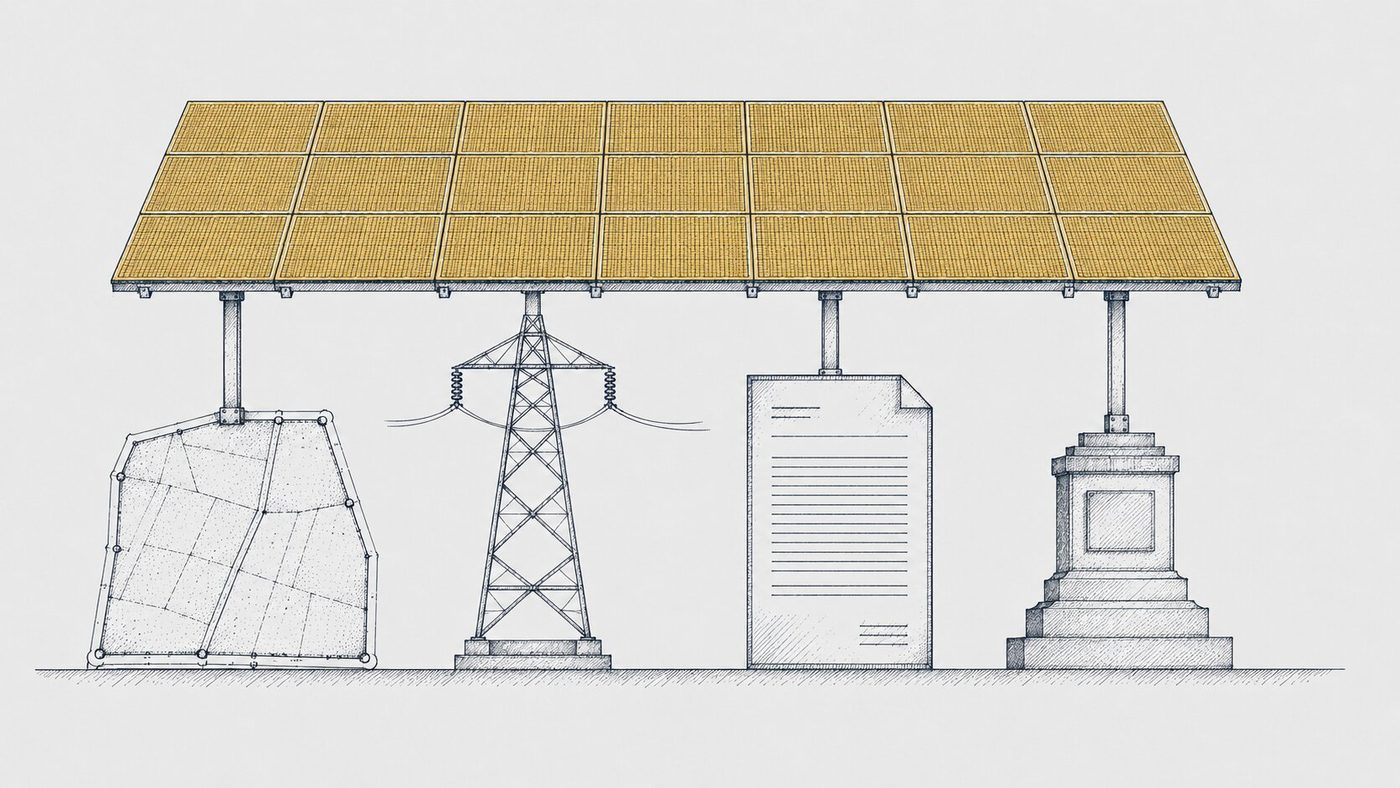
Consider what the work actually involves for a real asset that generates income, using land intended for an energy project as the example. The claim that such an asset backs an investment rests on a chain of specific facts, each of which someone has to have secured. The land has to be genuinely controlled, with title clean enough to survive scrutiny and tenure long enough to match the life of the investment. The asset has to be connected to whatever makes it productive, which for a power asset means an actual grid connection rather than a place in a queue for one. The income has to be contracted, through an offtake agreement with a counterparty able to pay, because a physical structure with no contracted buyer for its output is a cost rather than a source of income. And the legal structure has to give the investor an enforceable position against those specific assets, rather than a general claim on a balance sheet that happens to include them. Where each of those is true, the asset backs the claim; where any is missing, the claim is backed by that much less, whatever the label says.
The harder point is that these facts have to stay true, not merely be true at closing. Backing is a verb in the present continuous: a physical asset degrades if it is not maintained, an offtake counterparty that was creditworthy at signing can be downgraded partway through the tenure, and income that rested on a contracted price can weaken when that contract expires and the asset is left exposed to the market. Verifying the chain once, at diligence, establishes that the backing existed on that day. Keeping it real is a continuing job, which is why the party standing behind the claim is not finished when the deal closes; it is responsible for the asset management that keeps each link in the chain intact across the life of the investment. A label captures the snapshot. The work is the maintenance.
This is where the distinction between a claim on a formed asset and a claim on a balance sheet becomes concrete. A balance-sheet claim depends on the general creditworthiness of the entity that issued it, so the investor is relying on the borrower's overall capacity to pay, and the assets are collateral in a broad and often unspecified sense. A claim genuinely backed by a formed asset depends on that asset's own contracted income and realisable value, which can be assessed on their own terms and do not require the investor to underwrite an entire enterprise to understand what they hold. Both can be sound investments; they are not the same investment, and the word "asset-backed" is applied to both, which is exactly why it repays scrutiny rather than acceptance.
The point holds most firmly at the level of the specific asset, because backing does not travel across a category the way the word does. A claim is only as strong as the work securing the particular asset behind it, not the work that could be cited for assets of a similar kind, and evidence assembled for one asset does not carry over to another simply because both answer to the same label. This is where category words outrun the proof beneath them: the term describes a class, while the backing exists only asset by asset. The label invites the general reading; the discipline is to insist on the specific one.
For an allocator, this turns "asset-backed" from a comfort into a checklist. The useful response to the term is to treat it as the beginning of the diligence rather than the conclusion of it, and to ask, for the specific asset in question, whether the land is controlled, whether the connection is real, whether the income is contracted with a counterparty that can pay, and whether the legal position is enforceable against those assets rather than against a balance sheet. Each of those is answerable, and each answer is either yes with evidence or it is a gap. There is one more question the sophisticated allocator asks, because an enforceable claim is not the same as an easily realised one: recourse to a physical asset is recourse to a thing that then has to be operated, and stepping into a power plant or foreclosing on infrastructure carries restructuring and operating overhead that liquidating financial collateral does not. That cost is the price of the specificity, and it is a reason the operating capability of the counterparty matters as much as its underwriting, because the party best able to run or restructure the asset in trouble is usually the party that formed it in the first place. The strength of the backing is the sum of those answers, and it can be measured: a counterparty that has done the work, and can keep doing it, will be able to show it asset by asset, while a counterparty relying on the label will offer the label. The difference between the two is the difference the word is supposed to name, and it is visible to anyone who asks the asset to do what the grammar says it does.
Sources: Alternative Credit Council and Houlihan Lokey, Financing the Economy 2025.