Real assets are being formed far slower than capital is arriving to fund them.
Global capital is flowing into real assets at record scale. The constraint on real-asset income this cycle is not how much capital exists or which manager holds it, but whether the asset itself has been properly formed.
Smriti Suri · 1 August 2026
The allocator's question, in most cycles, is a question about selection: given a universe of managers and a menu of yields, which manager, and at what price. The discipline of the last two decades has trained sophisticated capital to treat the investment problem as one of choosing well among options that already exist, because for most of that period options were the scarce part and capital had to compete for them.
That framing is now partly out of date, at least in real-asset income, and the reason is visible in the flow of capital itself. The International Energy Agency reports that global energy investment is set to reach a record USD 3.3 trillion in 2025, of which roughly USD 2.2 trillion goes to clean energy against USD 1.1 trillion to oil, natural gas and coal. Investment in the electricity sector alone is set to reach USD 1.5 trillion, around 50 percent more than the total spent bringing oil, gas and coal to market. Capital is not hesitant about this space; it is arriving in the largest volumes on record.
Demand is equally settled. The same IEA analysis describes the onset of an age of electricity, in which power demand rises across industry, cooling, electric mobility, data centres and artificial intelligence at the same time. On the financing side, the Alternative Credit Council's Financing the Economy 2025, produced with Houlihan Lokey, puts global private credit at USD 3.5 trillion in assets under management, with deployment of USD 592.8 billion in 2024, up 78 percent on the prior year. Private capital has both the appetite and the machinery to fund real assets at scale, and the end demand those assets serve is proven rather than speculative.
So the two variables an allocator is trained to weigh, whether capital is available and whether the underlying demand is real, both point the same way: capital is abundant and demand is proven. In that configuration the interesting question is what remains scarce, because in an efficient market the scarce thing is where the return is.
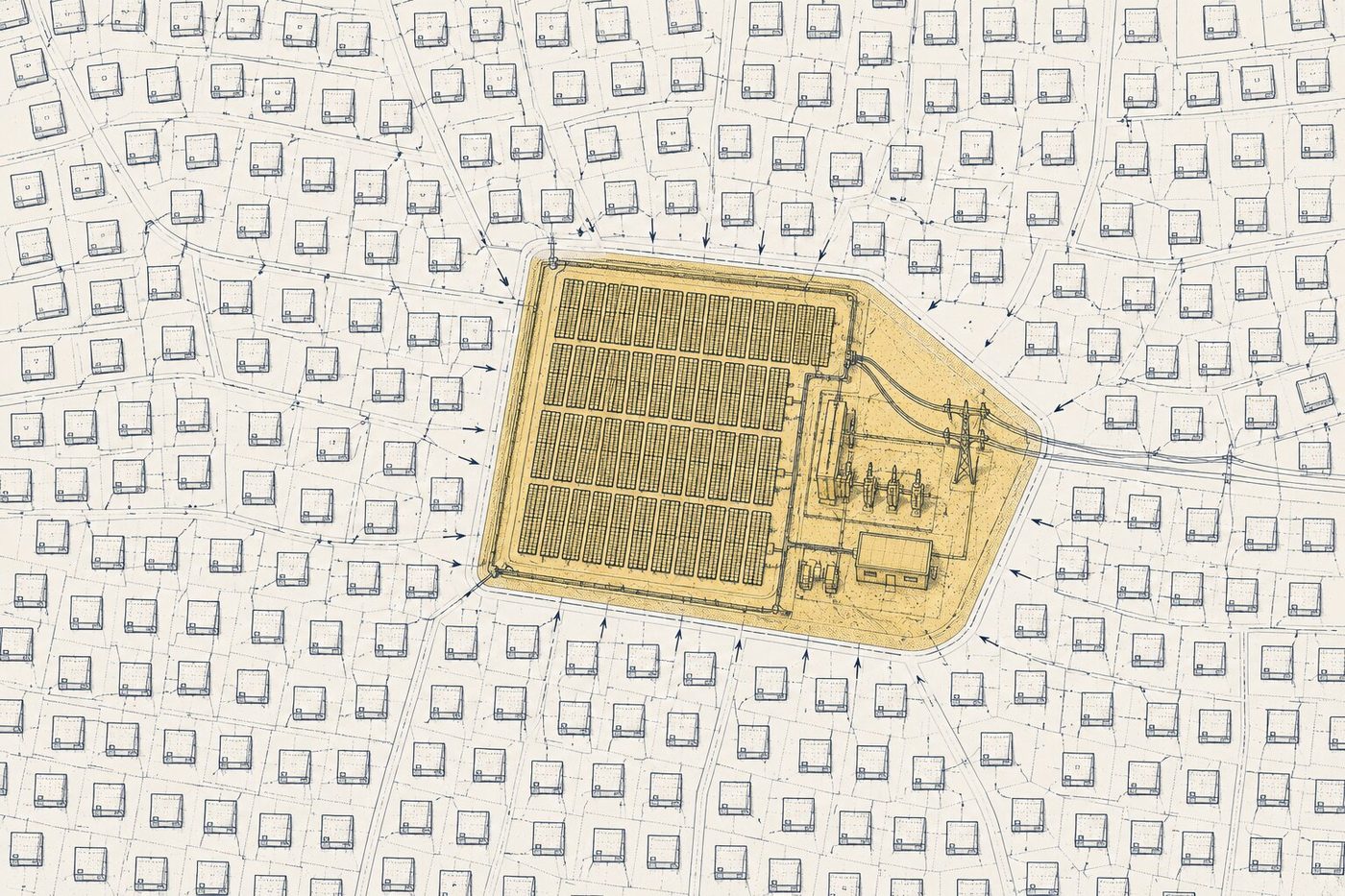
The scarce thing is formation. A financeable real asset is not a given that capital simply selects and funds; it is the end product of a long and failure-prone sequence: identifying and securing the land, obtaining the permissions and the grid connection, contracting the offtake that turns a physical structure into a stream of income, and assembling those pieces into something that can actually absorb institutional capital on terms an institution will accept. Each of those steps can stall, and some of them can fail outright, since a grid interconnection can be refused, an offtake counterparty can walk, and a permission can be denied late enough to strand everything spent reaching it. The return available upstream is not a free lunch or an inefficiency waiting to be arbitraged; it is the compensation for carrying assets through that sequence and absorbing the risk that they do not make it. That is precisely why it is durable. A premium that were merely mispriced would be competed away by the abundant capital described above, whereas a premium earned by surviving execution risk persists, because most capital cannot perform the execution. Abundant capital chasing a thin supply of well-formed assets is a description of the current market, and it explains why record investment totals coexist with allocators reporting that they struggle to deploy into real assets on terms they trust.
This reframes what the allocator is actually short of. The instinct is to hunt harder for yield, or to screen managers more finely, because those are the levers the selection framework offers; both levers operate downstream of the real constraint. Yield is a property of a formed asset, and you cannot select a yield into existence where the asset behind it has not been assembled. Manager quality matters, but competence in one part of the market does not transfer freely to another: a manager who excels at underwriting cash flows or pricing yields is exercising a financial skill, while forming an asset is an operational one, made of land acquisition, regulatory navigation and project development, and the two do not reduce to each other. This is why moving upstream is not simply a matter of an allocator redirecting the same capital at an earlier stage. The upstream position rewards an operating capability rather than a financial one, and capital without that capability faces the same thin supply and the same execution risk as everyone else, only without the means to manage it.
There is a useful test of whether an opportunity addresses the formation gap or merely repackages what sits downstream of it: ask where in the sequence the return is generated, and ask how much of the bottleneck the counterparty actually controls. Part of the current scarcity is administrative rather than structural, since grid queues and permitting backlogs are policy-sensitive and could ease if governments streamline them, which would shift some advantage back toward downstream owners. That is a real qualification and worth holding in view. What does not ease with faster regulators is the rest of the sequence, the securing of land, the contracting of income, the assembly of a financeable structure, which remains operational work whatever the permitting timetable. If the answer to the test is that capital is being placed into an asset someone else has already formed, the investment is a claim on a scarce good priced by the competition to hold it, and the abundant capital described above is that competition. If the answer is that the return is generated by carrying assets through formation, then the investment is positioned on the scarce side of the market, and on the part of that scarcity that policy cannot quickly legislate away.
None of this argues against selection. An allocator still has to choose well, and the discipline of comparing managers and pricing yield does not stop being necessary. The argument is narrower and, for this cycle, more consequential: selection is the second question, and this market has quietly promoted a first one. Before asking which formed asset to buy and at what yield, the allocator should ask whether the counterparty is a source of formed assets or a competitor for them, and whether it holds the operating capability that turns formation risk into formed income. In a market where USD 3.3 trillion is moving and the demand is not in doubt, where does the durable return live?
Sources: International Energy Agency, World Energy Investment 2025. Alternative Credit Council and Houlihan Lokey, Financing the Economy 2025.